
A free ERP for any business, in any country
Sales, stock, purchasing, the till, the books, the people. One system, Arabic and English, in your own currency — and you can start today without a credit card.
Start free — two minutes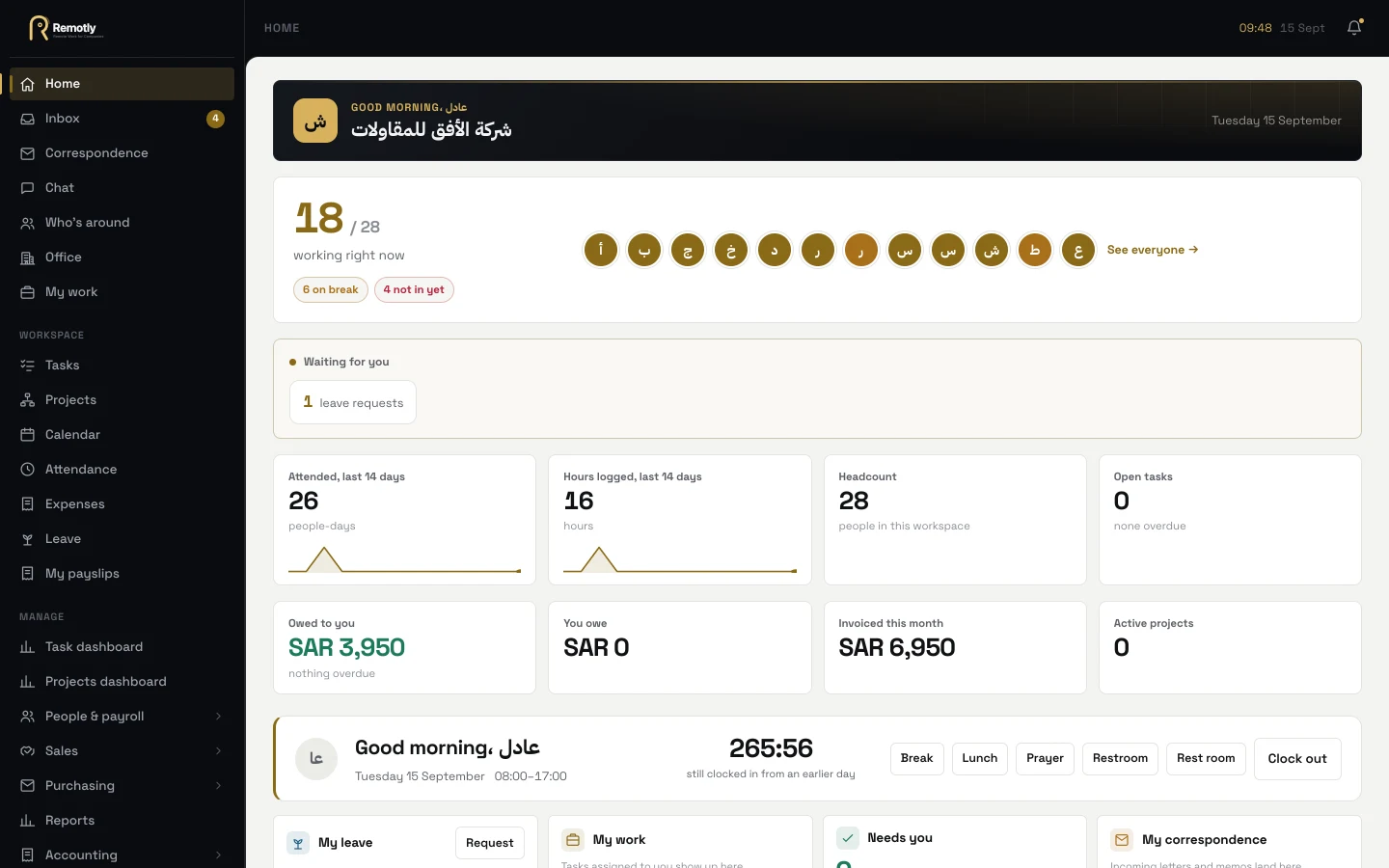
Point of sale
A counter till and a restaurant floor, with the drawer reconciled per payment method.
Inventory
Stock that moves between places instead of appearing and vanishing, and is valued in the ledger.
Accounting
Double entry, a real chart of accounts, invoices, bills and payments.
People
Attendance, leave, approvals and employee records for the same company.
What “free” means here
It means you create a company, invite your team, and start working — with no credit card, no trial clock counting down, and no cap on how many people you put in it. Most systems that call themselves free give you one user, or thirty days, or a feature list with the useful half greyed out. Remotly gives you the working product and asks for nothing up front.
It also means you switch on only what you use. A barber does not need a warehouse and a wholesaler does not need a dining room, so the apps are installed per company: the menu shows what you turned on and nothing else, and you can turn more on the day the business needs it.
Any country, and that is a technical claim not a slogan
Most systems built for one market quietly assume its shape: two decimal places on money, a Monday-to-Friday week, one warehouse, one language reading left to right. Each of those assumptions breaks a real business somewhere, and the breakage is usually silent.
Remotly writes money the way each currency is actually written — three decimal places in Kuwait, Bahrain, Oman and Jordan, none in Japan — so a bill split across two cards adds up to the last fils instead of being rejected. Each branch keeps its own timezone, working days and weekend. The interface is Arabic first with genuine right-to-left layout, and English for the people who need it.
- Your own currency, written with the number of decimals that currency really uses.
- A working week and weekend per branch, not one imposed on the whole company.
- Arabic as a first language throughout, including the printed receipt.
- No statutory figures are asserted anywhere — leave, tax and end-of-service follow the policy your company configures.
The parts talk to each other, which is the whole point of an ERP
A spreadsheet for stock, an app for the till and an accountant with a shoebox is not a system — it is three descriptions of the same day that never agree. In Remotly the till sells a dish, the recipe takes its ingredients out of the store, the store’s value moves in the ledger, and the shift reconciles against what is actually in the drawer. One event, recorded once.
The same goes the other way: a purchase order is received into stock, and the supplier’s bill clears what the receipt already put on the books instead of charging the company twice for the same delivery. That is the difference between modules that share a login and modules that share a ledger.
Set up for the business you actually are
When you sign up you say what the business is — a restaurant, a garage, a pharmacy, a perfume shop, a contractor, a clinic — and Remotly configures itself for it: the right apps switched on, shop hours instead of office hours, and the departments that trade actually has. Thirty-two trades and counting, and the list grows by request.
Common questions
Is it really free, or free for thirty days?
Really free, with no credit card and no cap on users. Paid plans exist and add the advanced modules; the free plan is a working system, not a countdown.
Can I use it outside the Gulf?
Yes. You choose the country, currency, timezone and working week when you create the company, and each branch can differ. The interface is Arabic and English.
Does it handle tax or e-invoicing compliance?
Remotly records the tax rates your company configures on its invoices and reports on them. It makes no compliance claim for any country’s e-invoicing regime, and asserts no tax rates of its own.
What if I only want one part of it?
That is the normal case. Apps are installed per company, so a shop can run the till and stock and never see a project board.