
Free inventory software where stock never appears from nowhere
Every quantity you own is somewhere, and every change is a move from one place to another. That one rule is why the numbers still add up a year later.
Start free — two minutes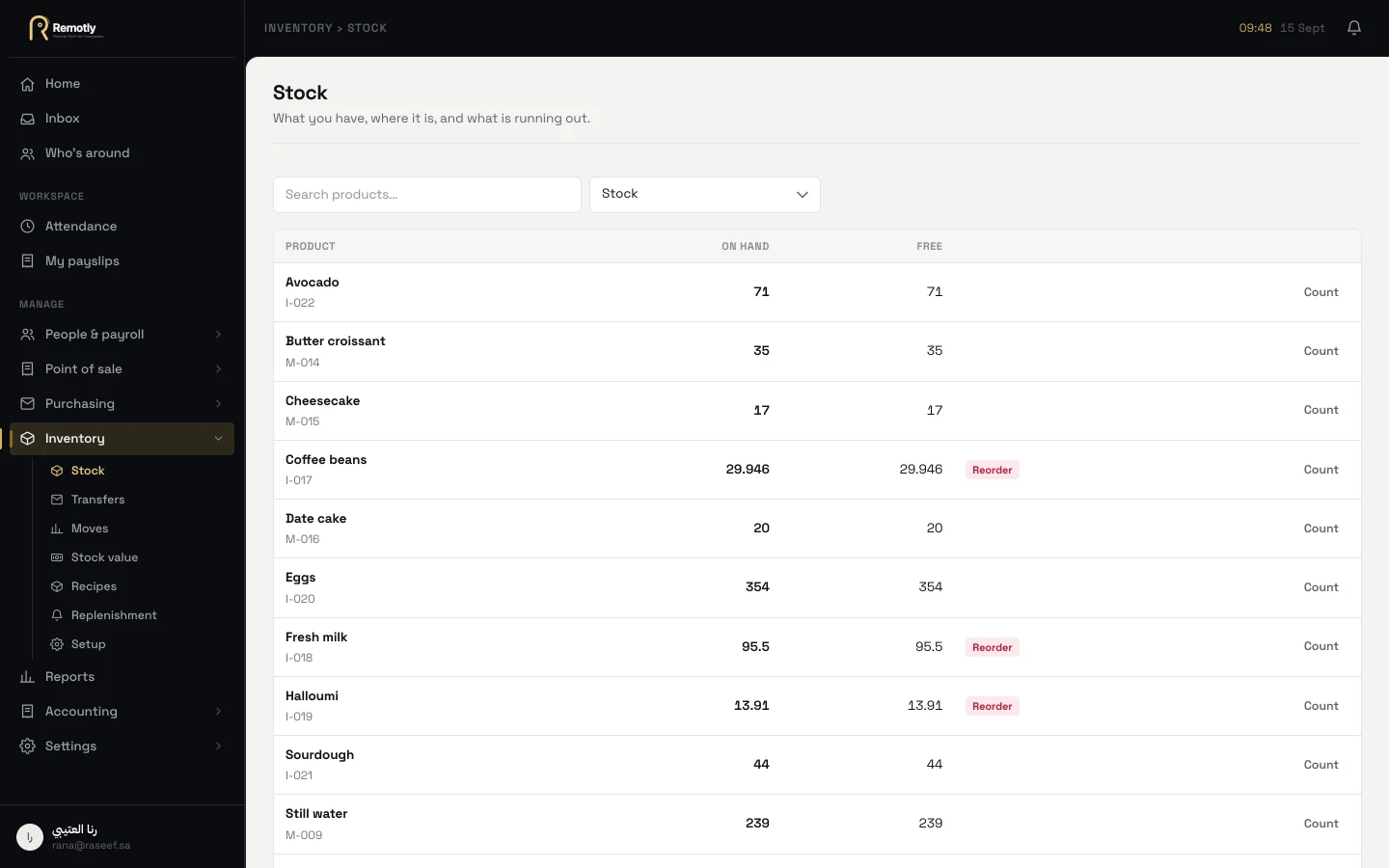
Stock by place
The front shelf, the back room, the van — each with its own quantity.
Transfers
Plan a move, reserve the goods, deliver part of it, and raise a backorder for the rest.
Counts
A count is a move to an adjustment location, so a shortage leaves a trail.
Valuation
FIFO, average or standard cost, posted to the ledger as the goods move.
Why “+10 / −10” loses your stock
Most simple stock tools store one number per product and add to it or subtract from it. The moment two people edit the same item, or a return is entered twice, or somebody fat-fingers a count, the number is wrong — and nothing in the system can tell you it is wrong, because there is nothing to compare it against.
Remotly records a movement instead: a hundred pieces did not appear on the shelf, they moved from the supplier to the shelf. Three did not vanish at the till, they moved from the shelf to the customer. Because every change has two ends, the quantities across all places always sum to exactly zero — and the system checks that after every single operation. If it ever broke, you would be told, rather than finding out at the annual count.
- Every movement keeps its reference — a sale, a purchase, a transfer, a count.
- Balances are derived from the movements and can be rebuilt from them at any time.
- Receive in cases and sell in singles: units convert, and the count stays in pieces.
- A count against the wrong shelf is refused rather than silently doubling your stock.
Transfers that behave like real deliveries
A transfer is planned first, then reserved, then delivered. Reserving matters: goods promised to tomorrow’s delivery cannot be sold off the shelf this afternoon by somebody who did not know about it, and if you try, the system says how many are actually free and which transfer is holding the rest.
When only part of a delivery arrives, you validate what came and Remotly raises a backorder for the remainder — a second document, linked to the first, so nobody has to remember that four of the ten are still owed.
Stock has a value, and the books should know it
Choose how each product category is costed — first in first out, moving average, or a standard cost you set — and Remotly values every movement as it happens and posts it. Goods arriving debit the stock asset; goods sold credit it and charge cost of sales. The balance on the stock account in your ledger equals the value of what is on the shelves, and that is checkable rather than hoped for.
It also closes a hole that quietly overstates costs in a lot of systems: when a receipt has already put stock on the books, the supplier’s bill clears that entry instead of charging the expense a second time for the same delivery.
Knowing what to order before you run out
Set a minimum and a maximum per product and location, and Remotly lists what has fallen below its line and how much to order to get back to the top of it — rounded up to whole cases where you buy by the case. It is a proposal, not an automatic order: the person who knows the supplier still presses the button.
Common questions
Can I have more than one warehouse or shelf?
Yes, as many internal locations as you need, each with its own balance, plus the counterpart places goods come from and go to — suppliers, customers, scrap, adjustments and production.
Does it work with the point of sale?
Yes. A sale moves goods out as it is recorded, and a dish with a recipe moves its ingredients. A refund puts them back.
Does it track batches, serial numbers or expiry dates?
Not yet — that is the next piece of work on this module, and we would rather say so than imply it. Everything described on this page is in the product today.